From the Editor
Dear readers,
Another high-profile legal case in Nigeria has reminded us that even family drama can carry million-dollar stakes. For trouble to remain out of paradise, settling domestic disputes behind closed doors remains key.
Twin sisters Ameena and Zara Indimi just won a $43.5 million settlement against their father, oil magnate Mohammed Indimi, highlighting how governance, ownership, and internal disputes in private businesses can ripple across finances and reputation.
Meanwhile, Africa’s natural resources are rewriting the rules of global trade. Ghana is turning an $11.4 billion gold smuggling headache into a $20 billion legal pipeline.
Zimbabwe, on the other hand, took a bold step to control its mineral exports, halting raw material shipments and asserting national leverage amid collapsing lithium prices.
Over in the land of the free, Donald Trump is insisting that big tech companies find a way to generate their own electricity instead of depleting the supply of the common folks.
 | Victor Oluwole, Editor-In-Chief, Business Insider Africa. |
✨ Today’s Must Read
Nigerian oil magnate Muhammadu Indimi ordered to pay daughters $43.51 million in dividend feud

Mohammed Indimi (Photo Credit: muhammaduindimi.foundation/X )
What began as a typical family matter over dividend rights in the family business has evolved into a high-profile legal case that has caught the attention of the corporate world.
Twin sisters Ameena and Zara Indimi, born into one of Nigeria’s most influential business families, have obtained a $43.51 million settlement against their father, billionaire oil entrepreneur Mohammed Indimi, when a Federal High Court ordered Oriental Energy Resources to compensate them for unpaid dividends.
Both sisters claimed that, although they jointly owned 10% of the company, their stock had been reduced without their approval, thus disqualifying them from a $435 million dividend payout linked to offshore oil earnings.
Why This Matters
The case highlights how governance, ownership disputes, and family dynamics in private companies can have major financial and reputational consequences for high-stakes businesses.
The Big 3

Gold nugget (Photo Credit: Marko Ivanov/Unsplash)
🇬🇭 Ghana moves to turn gold smuggling crisis into a $20 billion opportunity
Ghana is trying to turn a smuggling headache into a structured $20 billion pipeline. A problem that has seen the country lose about $11.4 billion is being addressed by a simple strategy: legalize what has often been labelled illegal.
Ghana plans to channel 127 metric tons of artisanal and small-scale gold into formal trade each year, tightening control over a segment long associated with leakages and lost foreign exchange. At the center is the newly created Ghana Gold Board (GoldBod), which will buy at least 2.45 tons of ASM gold weekly, manage off-take agreements, hedge price risk, and control exports.
The reform follows an estimated 229-metric-ton export gap worth $11.4 billion between 2019 and 2023, much of it believed to have sold to Dubai. For investors, this is about governance and currency stability. All forex proceeds will be routed to the central bank, reinforcing reserves while formalizing a fragmented sector.
🇨🇦 Canadian mining giant discovers rare earth and critical mineral in Botswana amid U.S.–China supply race
The global rare earth chessboard has a new piece, and it's located somewhere in Southern Africa. In the midst of all the tension in the US-China supply chain, this discovery feels less like a calm geological update and more like someone casually raising their hand and saying, "Don't forget about us."
Resources Limited, a base and precious metal exploration company in Canada, has confirmed a high-grade rare earth and critical minerals discovery at its Gchwihaba project, inserting both Botswana and Canada more firmly into the U.S.–China supply chain tug-of-war.
The deposit reportedly contains all 15 rare earth elements on the U.S. critical minerals list, alongside copper, cobalt, nickel, vanadium, and silver, a polymetallic mix sitting just 20 to 50 meters below the surface.
🇿🇼 Zimbabwe has taken the immediate decision to shut down the export of all its raw materials
The idea of an African nation controlling its resources without influence and interference from foreigners, which has been a hot-button subject in Africa for years, particularly in military-led countries, has recently found its way into Zimbabwe, going from idea to enforcement.
The Zimbabwian government on Tuesday halted the export of all raw minerals and lithium concentrate indefinitely, claiming misconduct and tax leakage.
The backdrop adds to the strategic nature of the action. Zimbabwe is currently Africa's biggest lithium producer, shipping 1.128 million metric tons of spodumene concentrate in 2025, despite world prices falling over 90% since their peak in 2022. Production is still increasing, with production expected to reach 160,000 tonnes of lithium carbonate equivalent by 2030. Rather than shipping raw materials to a poor market
AI & Innovation
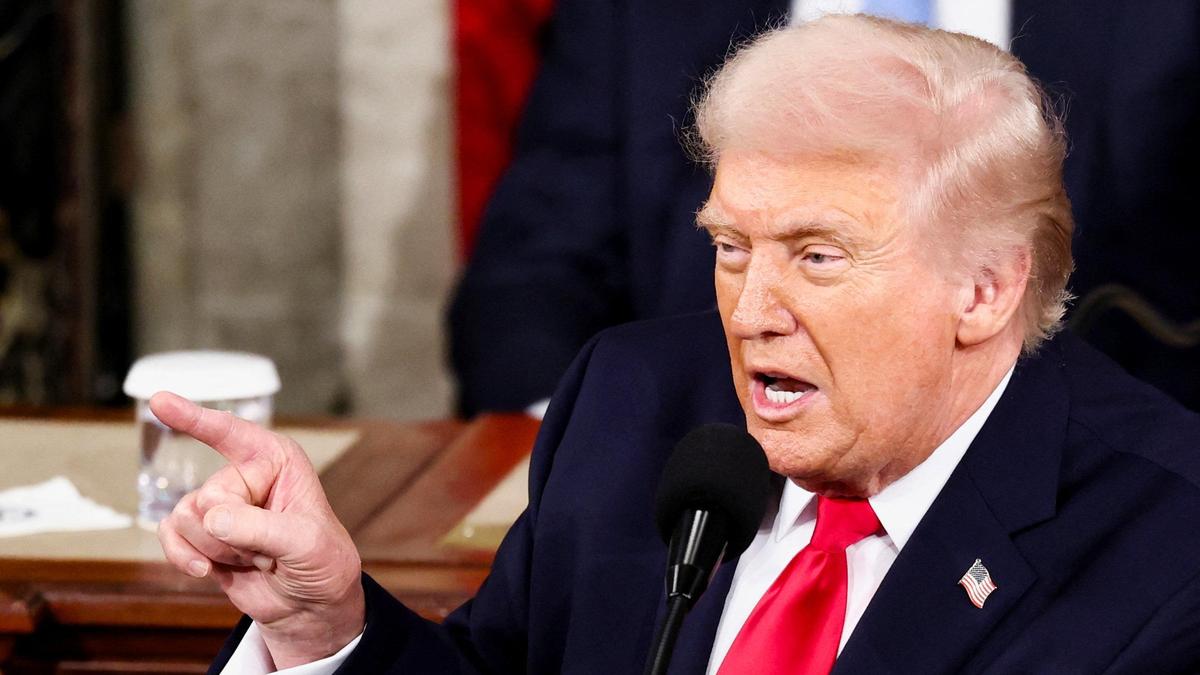
U.S. President Donald Trump delivers the State of the Union address in the House Chamber of the U.S. Capitol in Washington, D.C. on February 24, 2026. (Photo Credit: Reuters)
Trump wants Big Tech to build its own power plants. That's already starting to happen.
The proliferation of data centers has led to an equivalent surge in electricity demand, a development that has captured the attention of the dynamic and assertive US president, Donald Trump.
Simply put, AI is eating electricity, and President Trump wants the bill paid by the tech giants, not your household. In a recent State of the Union, he unveiled the “Ratepayer Protection Pledge,” pushing data centers to build their own on-site power plants to keep American electricity bills in check while fueling the AI boom.
Big Tech is already signing up. Companies including Microsoft, Amazon, OpenAI, and Anthropic plan natural gas-powered plants, with some projects already under construction across Texas, Virginia, New Mexico, and beyond. Nearly half of all new U.S. data centers aim to go “behind the meter,” bypassing traditional grid connections entirely.
Listicles
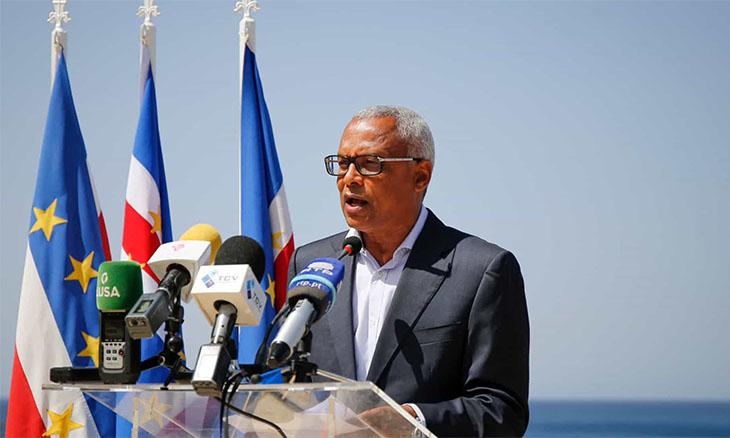
José Maria Neves (Photo Credit: Notícias ao Minuto)
African countries are showing steady gains in political rights and press freedom, showing stronger democratic openness. However, weak rule of law and corruption control continue to limit overall governance performance across much of the continent. Here are the top 10 best-governed countries in Africa, according to the latest ranking (2026).
S/N | Country | Governance Index |
|---|---|---|
1 | 🇨🇻 Cabo Verde | 74.0 |
2 | 🇲🇺 Mauritius | 68.4 |
3 | 🇳🇦 Namibia | 65.0 |
4 | 🇿🇦 South Africa | 62.3 |
5 | 🇧🇼 Botswana | 61.1 |
6 | 🇬🇭 Ghana | 60.2 |
7 | 🇸🇳 Senegal | 54.0 |
8 | 🇲🇼 Malawi | 50.7 |
9 | 🇸🇱 Sierra Leone | 48.0 |
10 | 🇬🇲 Gambia | 47.6 |
Source: World Economics Governance Index 2026
Geopolitics & Power
L-R Israeli President Isaac Herzog and Ethiopia's Minister of Foreign Affairs Gedion Timotheos (Photo Credit: X/@MFAEthiopia)
🇪🇹 3 major global powers arrive in Ethiopia in the space of one month
Addis Ababa, as presently constituted, is officially Africa’s new diplomatic hotspot. In just three weeks, Ethiopia has welcomed leaders from Israel, Turkey, and Italy, signaling its rising clout on the continental and global stage.
The latest visitor, Israeli President Isaac Herzog, arrived to discuss politics, trade, and technology partnerships, continuing a streak of high-profile engagements that underscore Ethiopia’s strategic appeal.
Turkish President Recep Tayyip Erdogan’s recent visit sealed a memorandum for joint energy and infrastructure projects, boosting industrial collaboration, while Italian Prime Minister Giorgia Meloni co-hosted the Second Italy-Africa Summit, unveiling the “Mattei Plan” to align sustainable development with the African Union’s Agenda 2063.
Business Implication
Ethiopia’s emergence as Africa’s diplomatic hotspot positions Addis Ababa as a strategic hub for investment, trade partnerships, and industrial collaboration across the continent.
Global Trends, African Impact
Nvidia's strong Q4 earnings are calming investor nerves amid stock fatigue in the AI sector. Steve Marcus/REUTERS
5 biggest takeaways from Nvidia's Q4 earnings — from the new Vera Rubin chips to addressing an emerging risk
NVIDIA just reminded Wall Street who’s really running the AI show.
The chipmaker blew past Q4 expectations, delivered a supercharged forecast, and showcased its growing grip on the AI ecosystem, from powering OpenAI’s latest Codex models to Meta’s push toward superintelligence. CEO Jensen Huang made it clear: if you’re building AI, you’re probably running on Nvidia.
For investors paying attention, the Q4 call offered five key lessons:
Nvidia remains the backbone of Big AI;
Strategic deals with OpenAI and Anthropic expand ecosystem control;
Vera Rubin chips will drive faster, more efficient inference;
Groq integration signals focus on specialized AI workloads without abandoning the core platform;
Data center capacity, energy, and capital remain critical risks that could impact future growth.
Executive Trivia
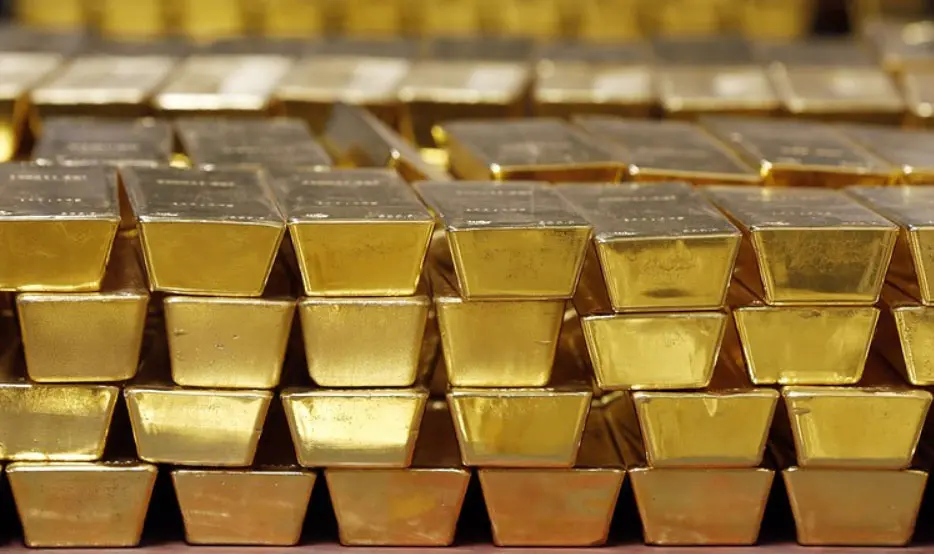
Photo Credit: GOLDBOD
Which African country is known as the ‘Gold Coast’?
Did You Know?

A pile of Gold Nuggests. (Photo Credit: suradeach saetang/Unsplash)
Ibn Haukal, writing in 951 AD, informs us that the king of Ghana was “the richest king on the face of the earth” whose pre-eminence was due to the quantity of gold nuggets that had been amassed by himself and his predecessors.
Know someone who'd enjoy this briefing?